Electrostatics and Mitochondria
The mitochondrial membrane potential is the potential difference across the inner mitochondrial membrane caused by proton pumps in the electron transport chain. Its value is often cited as about \( -150\, mV \). I can never remember the directional conventions for this, so I made the following sketch as a reminder:
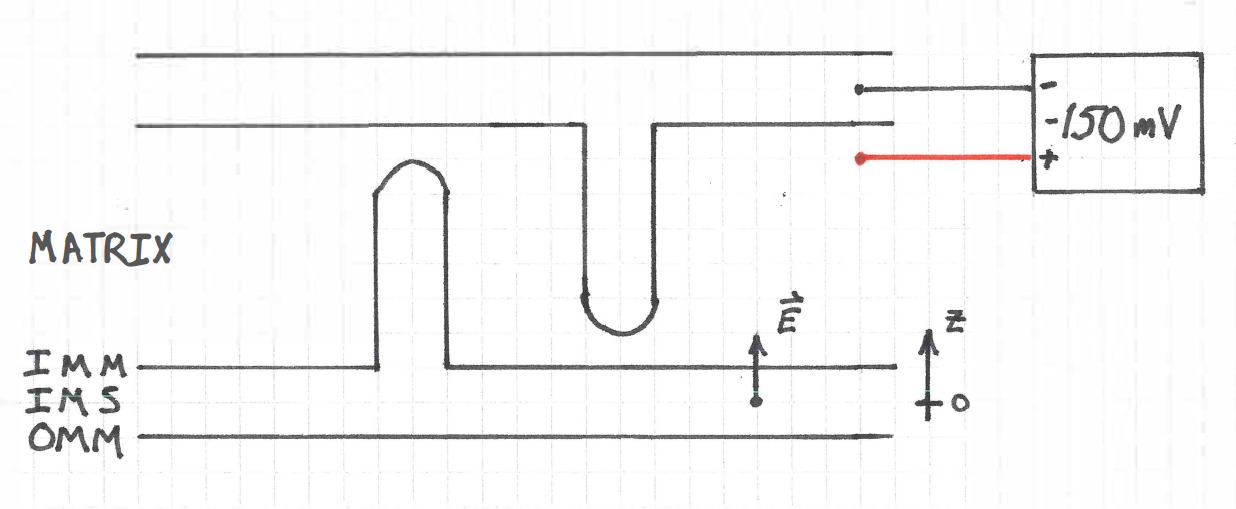
- IMM: Inner mitochondrial membrane
- IMS: Intermembrane space
- OMM: Outer mitchondrial membrane
If you stick the positive lead of a voltmeter inside the mitochontrial matrix and the negative lead in the intermembrane space, you will measure a voltage of about \( -150 \, mV \).
The electric field, which points from positive to negative charge, points from the IMS into the matrix. The definition of potential difference is
$$ \Delta \psi = -\int_C \vec{E} \cdot \, d \vec{\ell} $$
where \( C \) is the path of integration. In the absence of magnetic fields this integral is independent of the path and depends only on the value of the potential at its endpoints:
$$ \Delta \psi = - \left| \vec{E} \right| \times (z_{mat} - z_{ims}) $$
with \( z_{mat} \) and \( z_{ims} \) positions within the matrix and IMS, respectively. This equation also assumes that the electric field is uniform across the membrane, which is clearly a simplification.
The direction of integration is from \( z_{ims} \) to \( z_{mat} \). In the figure above the electric field \( \vec{E} \) and the path length differential \( d \vec{\ell} \) are parallel, so \( \vec{E} \cdot \, d \vec{\ell} \) is positive, and the negative sign in the definition results in a negative value for \( \Delta \psi \).
Comments
Comments powered by Disqus